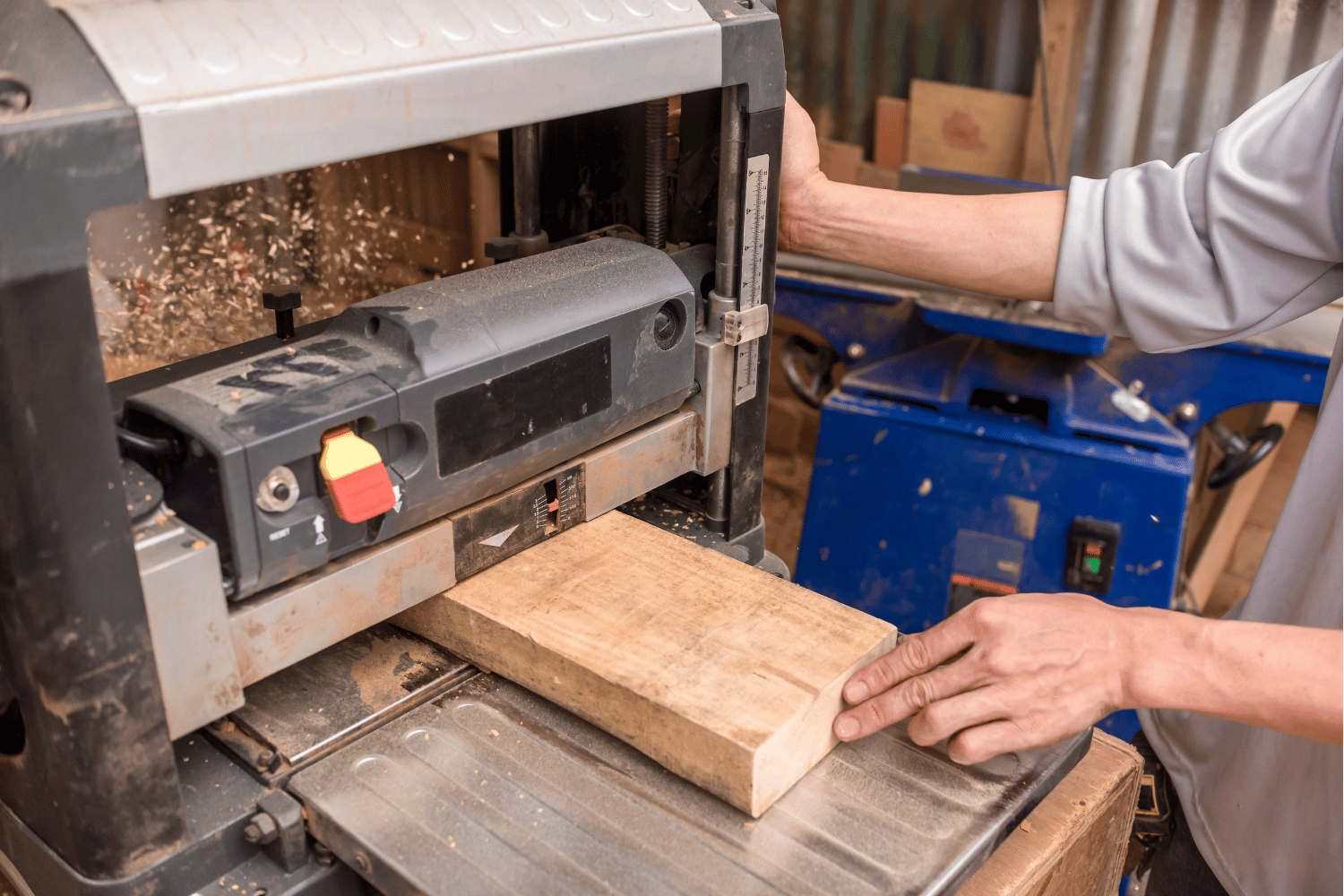
Best Benchtop Planer to Level Up Your Shop

Are the boards in your workshop looking a bit too…rough?
Or are they simply too big and bulky to do anything useful with?
If so, it might be time to break out the benchtop thickness planer.
Armed with nothing but minimal skill and elbow grease (and proper safety equipment of course!), you can take those boards from drab to fab—with a polished finish that would make even the most skilled woodworker proud.
This article will help you discover which benchtop planer is right for your projects so let’s dust off our sawdust-covered aprons and get started!
How We Choose the Best Benchtop Thickness Planers
It’s hard to know which benchtop thickness planer is the best for your needs.
There are so many different models with different features, and it can be tough to figure out which one is the right fit for you.
Even if you do manage to narrow down the list of potential benchtop thickness planers to a few models, it can still be tough to decide which one is the best for you.
After all, they all have their pros and cons, right?
We’ve done the hard work for you.
We’ve read through thousands of reviews on Amazon and considered the different features and specs to narrow it down to these benchtop thickness planers.
Not only that, but we’ve also created a buyer’s guide so that you can figure out exactly what you need in a benchtop thickness planer.
Overall Winner – Best Benchtop Planer
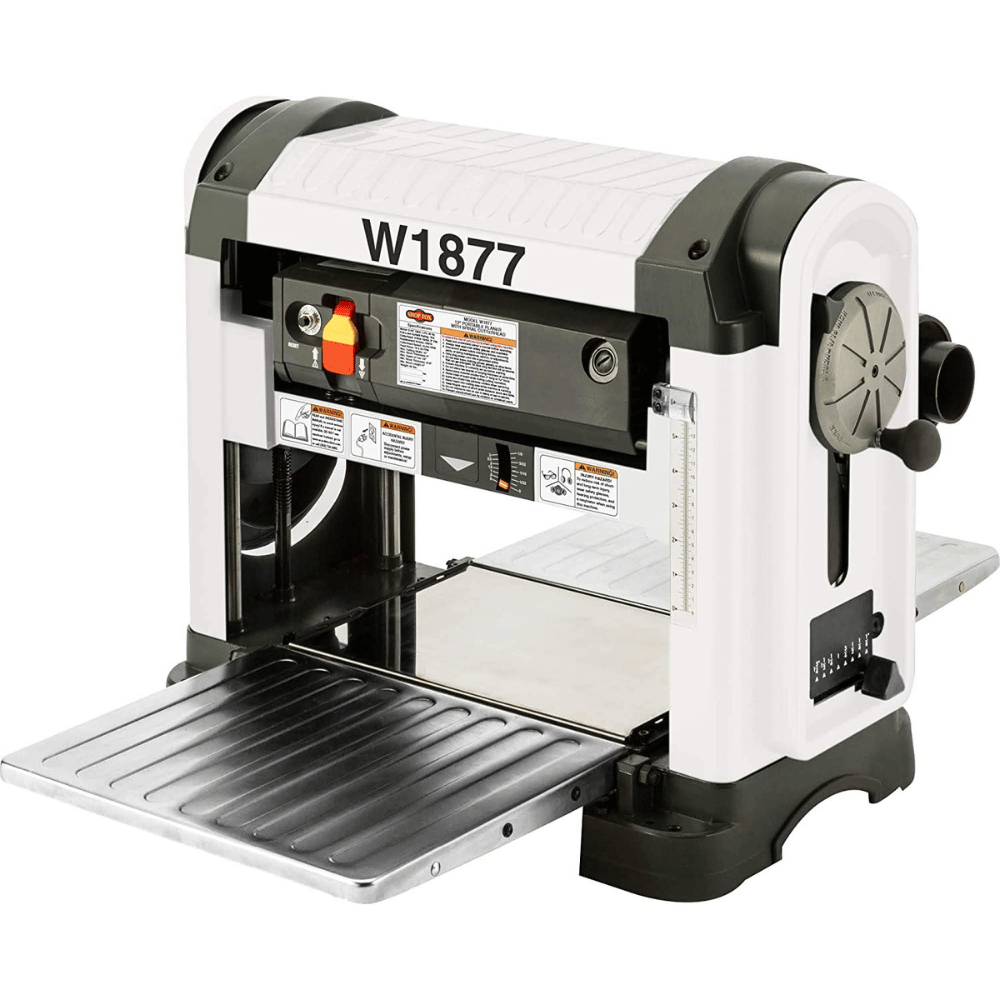
Shop Fox 13″ Portable Planer with Spiral-Style Cutter head (W1877)
Key Features
- 120V, 2HP, single-phase motor
- 13″ maximum width, 6″ maximum depth
- 1/8″ maximum cut depth
- 26 Feet per minute (FPM) feed rate
Why It’s a Great Choice
Lend a professional edge to your woodworking projects with the Shop Fox 13″ Portable Planer.
This professional-grade planer features a unique spiral-style cutterhead complete with 26 indexable carbide inserts for the smoothest of finishes, plus a 10,000 RPM cutterhead speed sure to give you consistent results – every time.
And it’s easy to use too thanks to its repeat cut selector, which allows you to quickly set the cutterhead to 6 pre-set heights from 1/8 in. to 1-3/4 in.
Enjoy added conveniences such as folding extension tables for storage and transport, as well as a cutterhead height lock for simpler production work!
It goes without saying that this portable planer is perfect for DIYers and serious woodworkers alike – so whether you’re crafting an heirloom planter or custom furniture pieces, let your projects reach perfection with Shop Fox’s ultimate planer!
Best Benchtop Planer for Low-Noise Operation
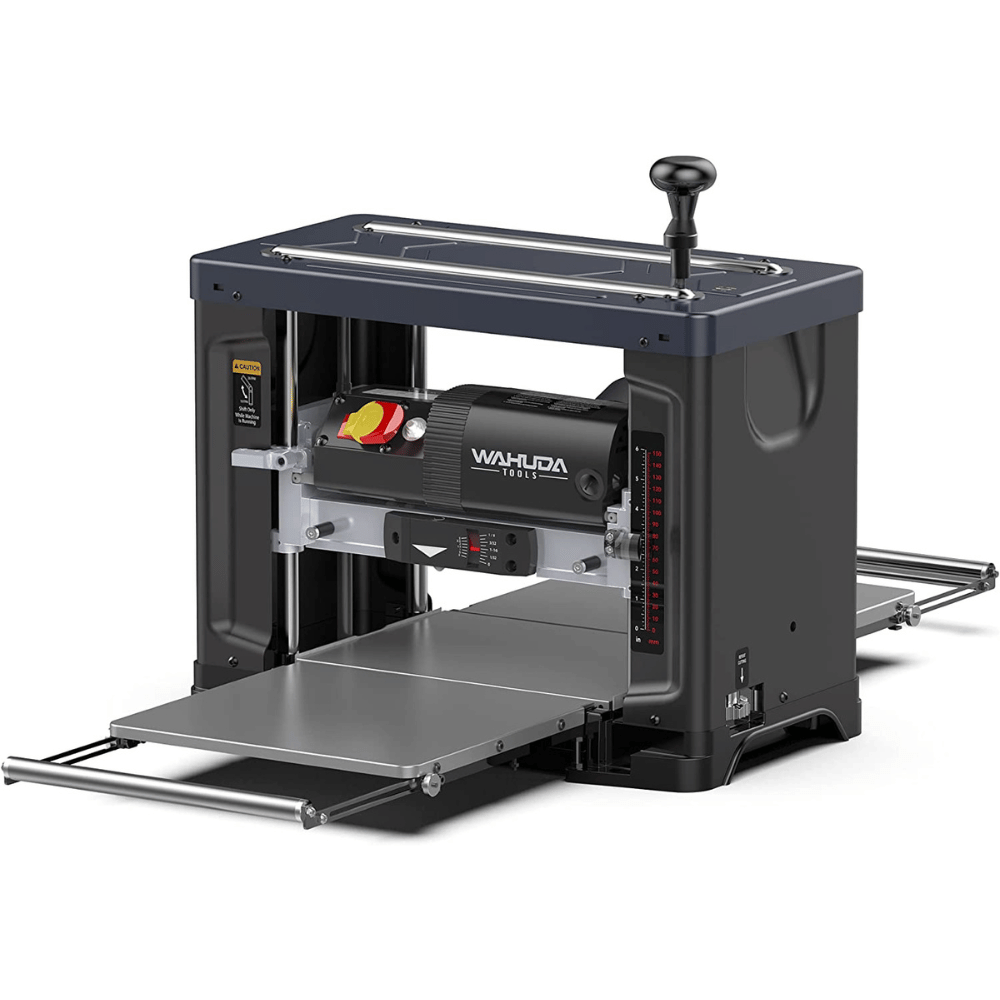
Wahuda Tools 13″ Spiral Cutter head Planer (60200PC-WHD)
Key Features
- 120V, 15 amp, single-phase motor
- 13″ maximum width, 6″ maximum depth
- 1/8″ maximum cut depth
- 18 or 26 FPM feed rate
Why It’s a Great Choice
Looking for a convenient planer for your woodworking needs?
Look no further than the Wahuda Benchtop Thickness Planer!
This easy-to-use planer is perfect for those looking to push their DIY and woodworking projects to the next level.
It features two feed speeds: 26 fpm for regular everyday production and 18 fpm for a finer finish on figured wood.
No more fussing around with replacing and rotating inserts – our planer is equipped with 4-sided carbide inserts that are ready to go right out of the box, and it’s quick and easy to access them with star knobs and hand-removable dust port screws.
And don’t worry about dust port size compatibility; this planer comes with an adapter to easily connect your collection device.
Get ready to experience flawless one-of-a-kind results faster than ever before with the Wahuda Benchtop Wood Planer!
Best Benchtop Planer for Quick Knife Changes
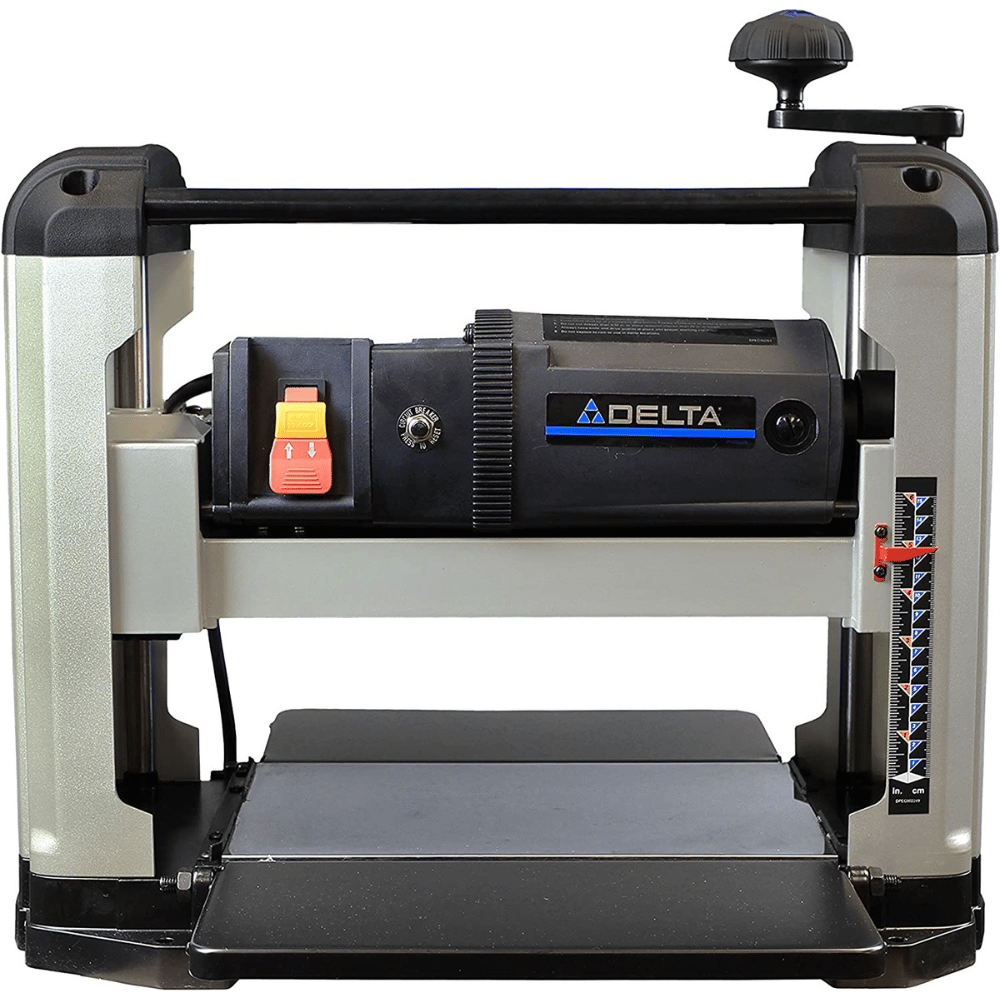
Delta Power Tools 13 In Portable Thickness Planer (22-555)
Key Features
- 120V, 15 amp, single-phase motor
- 13″ maximum width, 6″ maximum depth
- 3/32″ maximum cut depth
- 28 FPM feed rate
Why It’s a Great Choice
Looking to add a professional touch to your DIY crafting projects?
Look no further than the Delta Power Tools 13 In Portable Thickness Planer!
This planer allows you to make quick work of any wooden project you can think of.
You don’t have to worry about misaligning planks with its adjustable infeed and outfeed tables for better support.
The four column design provides excellent stability for smooth, accurate planning, which means you don’t need to bring in an expert or spend money on costly tools for precise cuts.
Best of all, it includes a quick-change knife system with dual edge disposable knives which makes the process nearly effortless and saves you time when setting up alignment jigs.
The Delta Power Tools 13 In Portable Thickness Planer is the perfect item for any woodworker that is looking for fast and easy results that won’t sacrifice quality.
Experience the convenience of powerful planing – without ever leaving home!
Best Benchtop Planer Capacity for the Money
WEN 15-Amp 13-Inch Spiral Benchtop Thickness Planer (PL1326)
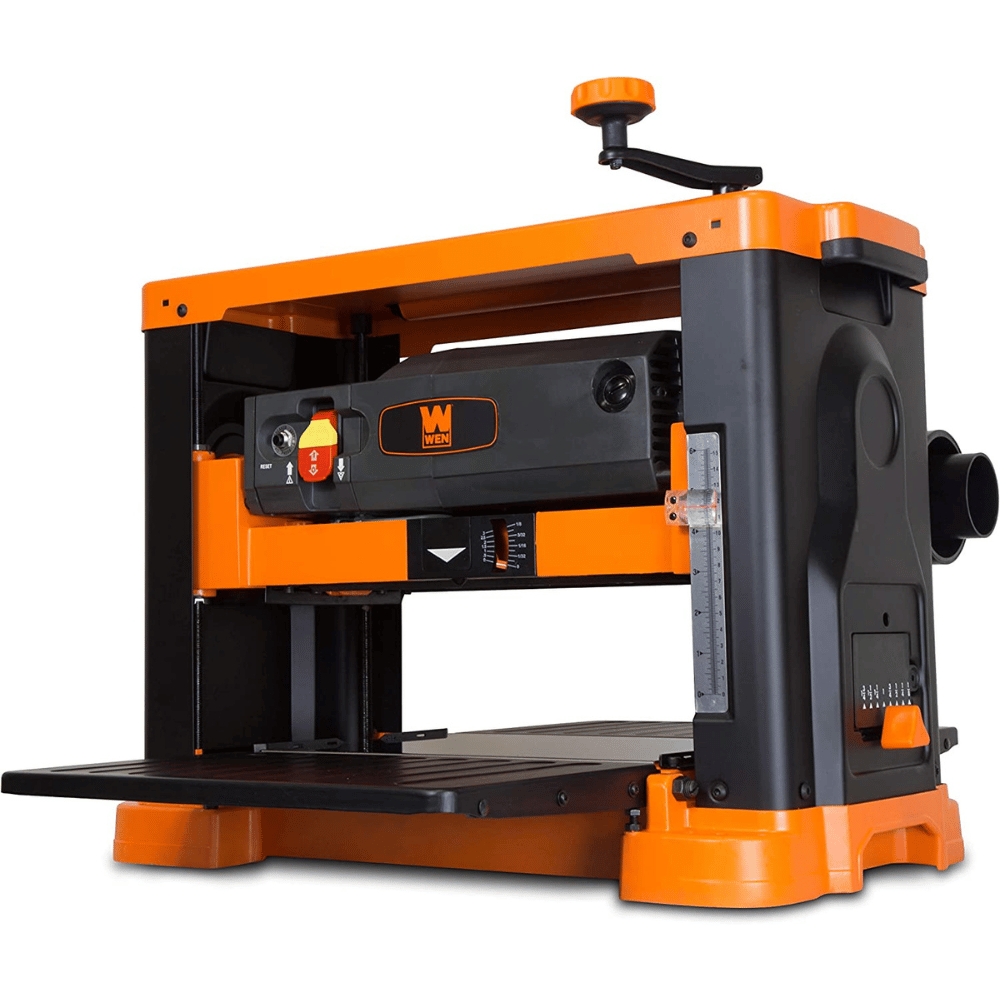
Key Features
- 120V, 15 amp, single-phase motor
- 13″ maximum width, 6″ maximum depth
- 1/8″ maximum cut depth
- 26 FPM feed rate
Why It’s a Great Choice
Are you ready to take your DIY game to the next level?
Place your chips on the WEN Benchtop Planer!
With it’s spiral cutterhead and 26 HSS blades, you’ll be sure to get a perfect finish.
Not sold yet?
Just wait until you hear about the powerful 15-amp motor that can rotate the cutterhead up to 10,000 RPM at a 26 feet per minute feed rate!
Wobbling planers are a thing of the past with this machine’s heavy duty cast iron base.
Plus, you don’t have to worry about snipe with its height adjustable infeed and outfeed tables.
You’ll also get an onboard planing gauge so you know exactly how much material is being removed during each pass – no more guesswork here!
Level up your projects with WEN’s 15-Amp 13-Inch Spiral Benchtop Thickness Planer and go from DIY novice to pro in no time.
Best Benchtop Planer for Deeper Cuts in Hardwood
DEWALT 12-1/2-Inch, 3-Knife Cutter Benchtop Planer (DW734)
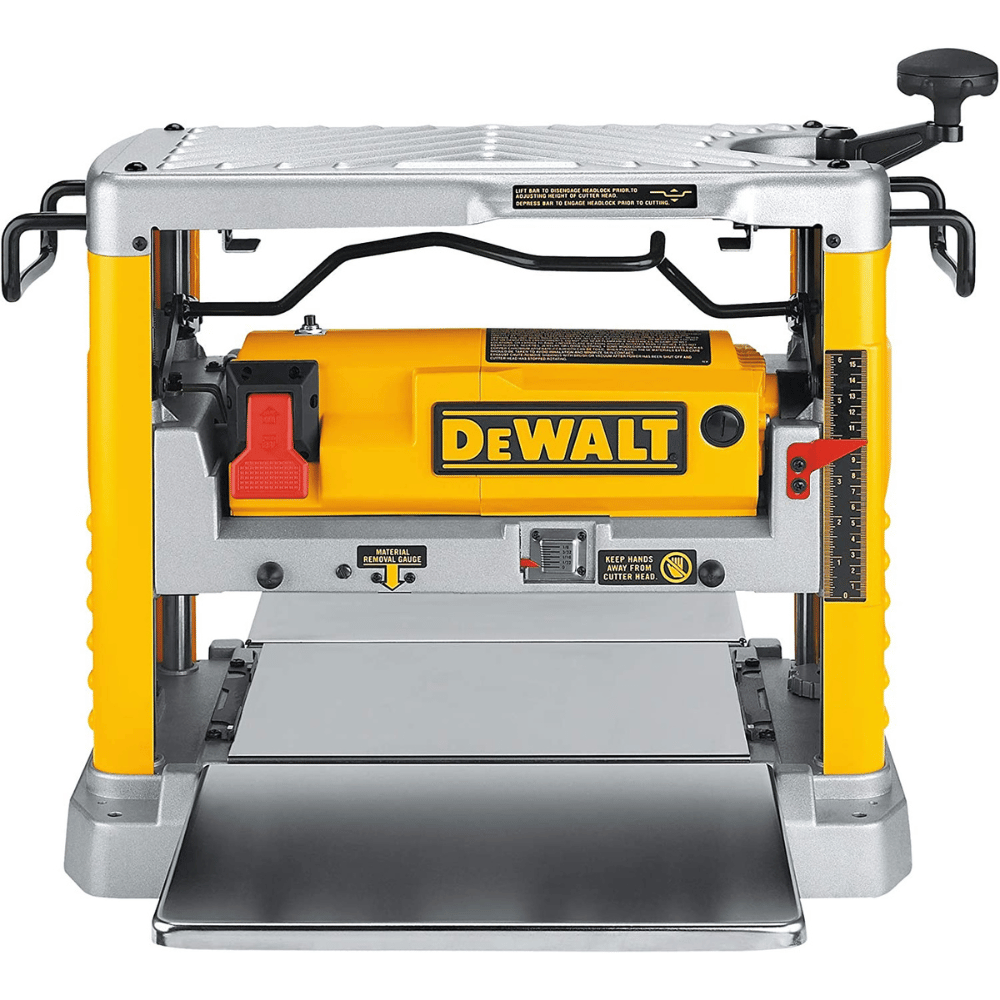
Key Features
- 120V, 15 amp, single-phase motor
- 12-1/2″ maximum width, 6″ maximum depth
- 10,000 RPM provides 96 cuts per inch
Why It’s a Great Choice
Are you bored of seeing the same old wood planers in the market?
We have something special for you – introducing this revolutionary DEWALT Planer!
This wood planer is designed for every DIYer and woodworker who is looking to upgrade their toolbox with something modern and high-performing.
Making precise cuts with this tool is easy breezy, thanks to its ultra-efficient three-knife cutter head with 10,000 rpm cutter-head speed that generates a fine finish and up to 96 cuts per inch.
And don’t worry about needing to change the knives frequently; the exclusive disposable, reversible knives provide 30% more knife life which makes them really great bang for your buck!
Plus, a four-column carriage lock also reduces snipe movement, so you can work more accurately and quickly – it’s just like adding icing on top of your beautiful carpentry projects!
To make it easier, there are extra-long infeed and outfeed tables which provide 33 1/2 inches of material support during use.
Plus a material removal gauge & large thickness scale helps with accurate cuts each time.
You can even save all your favorite thicknesses by using turret depth stop feature, so say bye bye to tedious tasks when working with wood!
Let DEWALT revolutionize your woodworking experience – embrace modern advancements with the DEWALT benchtop planer and never look back!
Best Benchtop Planer For Hobby Woodworkers
CRAFTSMAN Benchtop Planer with Two Knife Solid Steel Cutter Head (CMEW320)
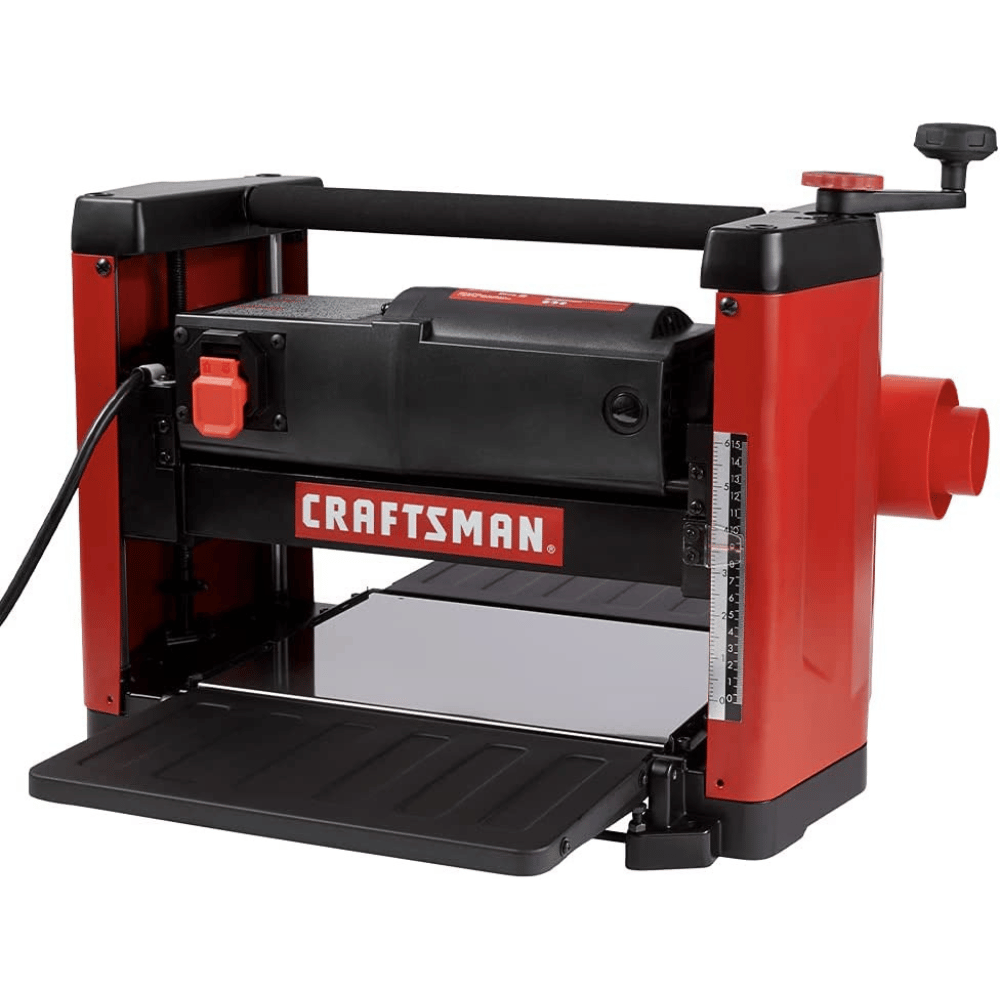
Key Features
- 120V, 15 amp, single-phase motor
- 12-1/2″ maximum width, 6″ maximum depth
- 8,000 RPM provides 16,000 cuts per minute
Why It’s a Great Choice
Do you love working on home improvement projects using wood?
If so, the CRAFTSMAN Benchtop Planer should be at the top of your list!
With its powerful 15 amp motor, you can tackle any hard or soft wood material removal effortlessly.
Not to mention, the Poly-V cutterhead drive promises maximum stock removal.
For an even smoother operation, the straight knife cutter head of this wood planer features two quick change knives mounted on ball bearings that will last for years.
The straight knives are made of high carbon steel, and they are double-edged and reversible to guarantee you a long cutting life and a vacuum port is integrated for dust collection to keep your workspace clean.
So why wait?
Unleash your inner DIYer with the CRAFTSMAN Benchtop Planer!
Best Benchtop Planer for Multiple Feed Rates
JET 13-Inch Benchtop Thickness Planer with Helical Cutter Head (JWP-13BT)
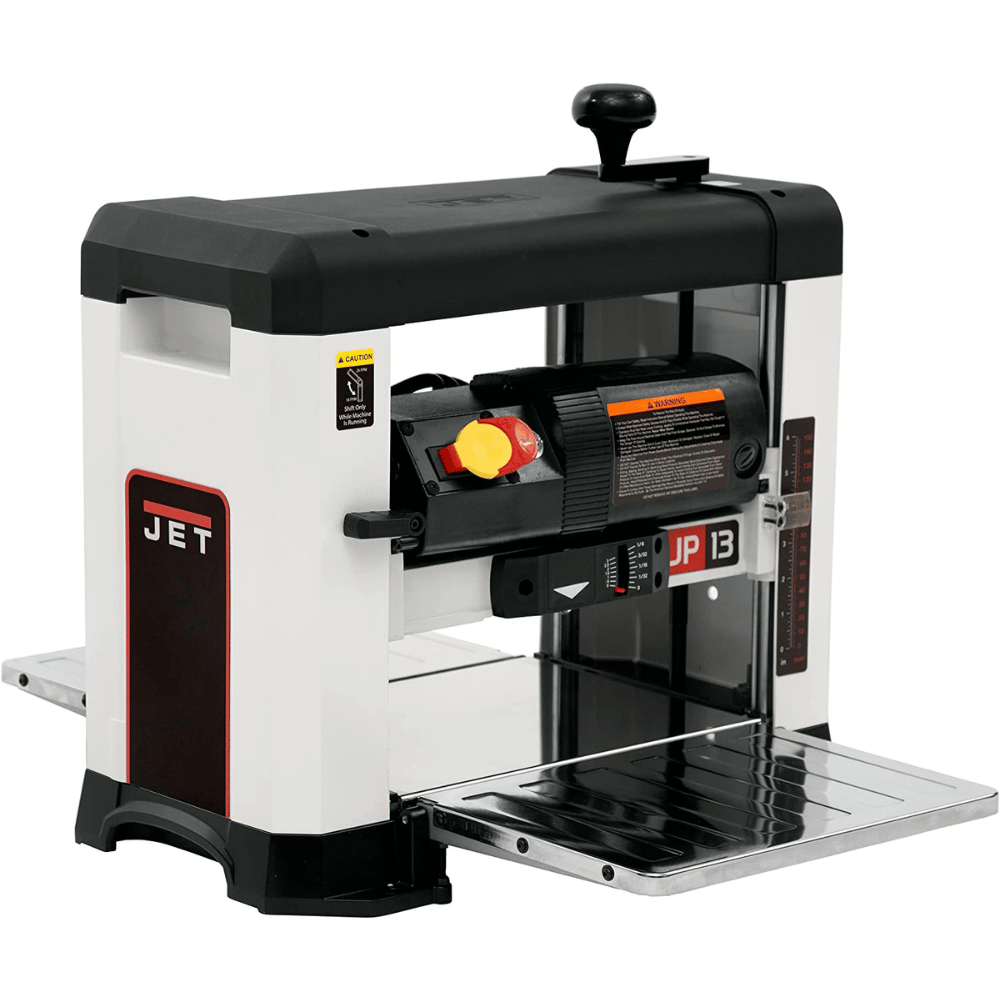
Key Features
- 120V, 2 HP, single-phase motor
- 13″ maximum width, 6″ maximum depth
- 1/8″ maximum cut depth
- 18 or 26 FPM feed rate
Why It’s a Great Choice
Get ready to slice through wood with precision, when you have JET 13-Inch Benchtop Planer by your side.
For those that take pride in their DIY projects and take woodworking into their own hands, this planer will help get the job done right!
With its 72 carbide inserts – 6 rows of 24 quick-change replacements – you can efficiently plane up to the perfect thickness without any hiccups or snags along the way.
And if one of them becomes dull or damaged, no worries!
Simply rotate it out or replace it quickly.
You might think super features like two infeed speeds and a rugged four post design come with a high pitched sound from its 2HP motor running at 10,000 RPM.
But not this machine!
The helical design helps keep all of the noise low, leaving you with a consistently smooth cut surface every single time so you can take pride in every project.
Plus, its cast iron base keeps it sturdy and solid on the floor while eliminating snipe.
Have confidence knowing that your projects are sure to look great each time thanks to JET’s 13 inch benchtop planer!
Buyer’s Guide to the Best Benchtop Planers
You’ve decided you need a benchtop planer, but you have no idea where to start.
Benchtop planers can be a little intimidating if you don’t know what you’re doing.
There are so many options and features to choose from, it’s hard to know where to start.
We’ve created this list of the most commonly asked questions about benchtop planers to help make your decision easier.
What is a benchtop planer?
A benchtop planer is a woodworking tool that is used to plane and smooth the surface of rough or uneven boards. It is typically a stationary machine that sits on a workbench or table and uses a set of rotating blades to shave off the surface of the wood to produce a flat, smooth surface. Benchtop thickness planers are commonly used by woodworkers, carpenters, and DIY enthusiasts to prepare rough lumber for further use in furniture making, cabinetry, and other woodworking projects. They come in various sizes and can be powered by electricity or manual labor.
What are the benefits of using a benchtop thickness planer?
There are several benefits to using a benchtop planer, including:
- Saves time and effort: A benchtop thickness planer can quickly and efficiently plane rough lumber into smooth, flat boards without the need for manual hand planing, which can be time-consuming and physically demanding.
- Produces uniform boards: A benchtop thickness planer can produce boards that are of uniform thickness and flatness, which is essential for creating high-quality woodworking projects.
- Cost-effective: Benchtop planers are available at a wide range of prices, making them accessible to both professional woodworkers and hobbyists. They can also save money in the long run by allowing users to purchase rough lumber at a lower cost and plane it to the desired thickness and flatness.
- Versatile: Benchtop planers can be used on a variety of different types of wood, including hardwoods, softwoods, and composite materials, making them a versatile tool in the woodworking shop.
- Precision: Modern portable thickness planers have advanced features, such as digital readouts and automatic feed rates, which allow for precise and accurate planing.
- Reduces waste: By producing a uniform and flat board, a benchtop thickness planer can minimize waste in a woodworking project by allowing the user to maximize the use of each board.
What kind of materials can I plane with a benchtop thickness planer?
A benchtop thickness planer is designed to plane and smooth rough-sawn lumber, which can be made of a variety of different materials, including hardwoods, softwoods, and composite materials.
Hardwoods are typically dense and require sharper blades and slower feed rates to produce a smooth surface. Softwoods, on the other hand, are less dense and can be planed more quickly with a faster feed rate. Composite materials, such as particleboard or MDF, can also be planed with a benchtop thickness planer, although they may dull the blades more quickly due to the presence of glue and other adhesives.
It is important to note that a benchtop thickness planer is not suitable for planing thin or delicate materials, such as veneers or plywood, as they may tear or split during the planing process. Additionally, the maximum thickness and width that a benchtop planer can handle will vary depending on the specific model, so it is important to check the manufacturer’s specifications before attempting to plane any material.
What is the difference between a benchtop planer and a jointer?
While both a benchtop planer and a jointer are used in woodworking to produce flat, smooth surfaces, they serve different purposes and have some key differences:
- Function: A benchtop planer is used to remove material from the surface of a board to produce a uniform thickness and smooth surface, while a jointer is used to flatten the face and straighten the edges of a board.
- Operation: A benchtop planer uses a set of rotating blades to remove material from the surface of a board, while a jointer uses a set of rotating blades to remove material from the edge or face of a board.
- Board Size: A benchtop planer can handle boards that are wider and thicker than a jointer, making it more suitable for larger woodworking projects.
- Cost: Generally, benchtop planers are less expensive than jointers, making them a more accessible tool for hobbyists and DIY enthusiasts.
- Complementary tools: While a benchtop planer and jointer can be used independently, they are often used together in woodworking projects. The jointer is used to prepare the board’s edges and faces, and the planer is used to produce uniform thickness and smooth surfaces.
In summary, a benchtop planer and jointer are both essential tools in the woodworking shop, but they serve different functions and are designed to handle different aspects of the woodworking process.
Can a benchtop planer be used as a jointer?
While a benchtop planer and a jointer are different tools with different functions, it is possible to use a benchtop planer to perform some of the functions of a jointer under certain conditions.
For example, if the board being planed has one flat face, it can be fed through the planer with the flat face down, which will result in the opposite face being planed parallel to the flat face. However, this method is not as precise as using a jointer and may not be suitable for all woodworking projects.
It is important to note that using a planer as a jointer may require additional setup and adjustment to ensure the board is properly aligned and the blades are set at the correct height. Additionally, it is not recommended to use a planer as a jointer for all types of wood which may result in tear-out or other damage to the board.
In general, while a benchtop planer can be used as a substitute for a jointer in certain situations, it is recommended to use the appropriate tool for each specific task to achieve the best results.
What safety precautions should I take when using a benchtop planer?
When using a benchtop planer, it is important to take appropriate safety precautions to avoid injury. Here are some safety tips to keep in mind:
- Read the manual: Before using a benchtop planer, make sure to read the manufacturer’s manual carefully to familiarize yourself with the tool’s operation and safety features.
- Wear personal protective equipment: Always wear eye protection, hearing protection, and a dust mask when using a planer to protect yourself from flying debris and sawdust.
- Use a push block: When feeding the board into the planer, use a push block or push stick to keep your hands safely away from the rotating blades.
- Avoid loose clothing: Avoid wearing loose clothing, jewelry, or long hair that could become caught in the planer’s moving parts.
- Keep the work area clean: Keep the work area clean and free of clutter to avoid tripping hazards and to allow for easy movement around the planer.
- Avoid using damaged or dull blades: Using damaged or dull blades can increase the risk of kickback, which can be dangerous. Make sure to inspect the blades regularly and replace them as needed.
- Unplug when not in use: Always unplug the planer when not in use and when making adjustments or changing blades.
By following these safety precautions, you can help minimize the risk of injury while using a benchtop planer.
How do I maintain a benchtop planer?
Proper maintenance of a benchtop planer can help ensure its longevity and keep it functioning at optimal levels. Here are some tips on how to maintain a benchtop planer:
- Clean the planer regularly: After each use, clean the planer’s surfaces, rollers, and blades to remove sawdust and debris. This can be done using a clean cloth or brush.
- Check and adjust the blades: Check the blades regularly to ensure they are sharp and not damaged. Adjust the blade height as needed to ensure a smooth cut.
- Lubricate moving parts: Lubricate the planer’s moving parts, such as the rollers and gears, with light machine oil to ensure they operate smoothly.
- Check and adjust the belt tension: Check the belt tension regularly and adjust it if needed to ensure smooth operation.
- Check the dust collection system: Make sure the dust collection system is functioning properly and clean it out regularly to prevent clogging.
- Store the planer properly: When not in use, store the planer in a dry, protected area to prevent rust or other damage.
- Follow the manufacturer’s instructions: Always follow the manufacturer’s instructions for maintenance and adjustment procedures.
By following these maintenance tips, you can help ensure your benchtop planer operates smoothly and lasts for many years.
What are the different types of blades used in benchtop planers?
Benchtop planers can use several types of blades, each with its advantages and disadvantages. Here are some of the most common types of blades used in benchtop planers:
- High-speed steel (HSS) blades: These are the most common type of planer blades and are made from high-speed steel. HSS blades are relatively inexpensive, easy to sharpen, and can be used for a variety of woodworking projects. They are typically noted as straight knife cutter heads.
- Carbide-tipped blades: Carbide-tipped blades are more durable than HSS blades and can stay sharp longer, making them ideal for heavy-duty planing projects. However, they are more expensive than HSS blades and may require special tools for sharpening.
- Helical blades: Helical blades have a spiral shape and are designed to make smoother cuts with less tear-out. They are more expensive than HSS and carbide-tipped blades but offer superior cutting performance.
- Disposable planer knives: Some benchtop planers use disposable planer knives that can be easily replaced when they become dull. These are often more expensive than traditional blades but can save time and effort in the long run.
When choosing blades for your benchtop planer, consider the type of woodworking project you will be working on, the type of wood you will be planing, and your budget.
Can I replace the blades in my benchtop planer?
Yes, you can usually replace the blades in a benchtop planer. It is often recommended to replace the blades periodically or when they become dull to ensure optimal performance and a smooth cut.
To replace the blades in a benchtop planer, follow these steps:
- Turn off and unplug the planer: Make sure the planer is turned off and unplugged before attempting to replace the blades.
- Remove the old blades: Using a wrench or other tool, loosen and remove the bolts holding the old blades in place. Carefully remove the old blades and set them aside.
- Install the new blades: Carefully align the new blades with the cutter head and tighten the bolts to hold them in place.
- Adjust the blade height: Adjust the blade height as needed to ensure a smooth cut.
- Test the planer: Before using the planer, test it on a scrap piece of wood to ensure the blades are properly installed and adjusted.
Note that the process for replacing blades may vary depending on the specific model of benchtop planer you have. Be sure to consult the manufacturer’s instructions before attempting to replace the blades.
Are there any additional accessories I should consider when purchasing a benchtop planer?
Yes, there are several accessories you may want to consider purchasing to enhance the functionality of your benchtop planer:
- Dust collection system: A dust collection system can help keep your work area clean by capturing sawdust and debris as you plane. Some benchtop planers come with a built-in dust collection system, while others require a separate dust collector.
- Infeed and outfeed tables: These can help support long or wide pieces of wood as they are planed, making the process safer and more efficient.
- Digital readout: A digital readout can help you accurately measure the thickness of the wood being planed and adjust the blade height accordingly.
- Sharpening tools: If you are using HSS or carbide-tipped blades, you may want to invest in a sharpening tool to keep your blades sharp and performing at their best.
- Planer sled: A planer sled can be used to flatten and thickness irregularly shaped or very large pieces of wood that might not fit easily on the planer bed.
- Blade guard: A blade guard can help protect your fingers and hands from sharp blades during operation.
- Mobile base: A mobile base can be used to make your benchtop planer easier to move around your workshop or garage.
When purchasing accessories for your benchtop planer, be sure to check compatibility with your specific model to ensure they will fit and function properly.
What is snipe when using a benchtop thickness planer?
Snipe is a common issue that can occur when using a benchtop planer. Snipe is the term used to describe a small indentation or groove that can appear at the beginning or end of a board being planed. It occurs when the cutter head lifts the board slightly as it enters or exits the planer, resulting in an uneven surface.
Snipe can be caused by a variety of factors, including improper adjustment of the infeed and outfeed tables, uneven pressure applied to the board as it is fed into the planer, or worn or damaged blades.
To reduce snipe when using a benchtop planer, follow these tips:
- Use infeed and outfeed tables: Make sure the feed tables are properly adjusted to support the board being planed and minimize any lifting or dropping of the board as it enters or exits the planer.
- Support long boards: For longer boards, use additional support at both ends of the board to ensure a consistent feed rate and minimize snipe.
- Feed boards evenly: Apply even pressure when feeding the board into the planer to prevent it from being lifted or dropped as it enters or exits the planer.
- Check and adjust blades: Check the blades on your planer regularly for any signs of wear or damage, and adjust or replace them as needed.
- Take light cuts: Taking lighter cuts with the planer can help reduce snipe and result in a smoother surface.
By following these tips and taking care when using your benchtop planer, you can help minimize snipe and achieve a smooth, even surface on your wood projects.
Choosing the Best Benchtop Planer for You
We’ve navigated the complicated search for benchtop planers and narrowed it down to these excellent options.
Depending on your particular needs and budget, any of these planers should provide a satisfactory experience in woodworking.
It’s time to reinvigorate your craft with one of these powerful tools – join us as we step up our workshop game!
If you’re ready to get started, click the links to check prices on Amazon and order yours now!
Then hit the woodshop and show us what you’ve got – let’s make something awesome!