Best Jointer for Sharp, Square Edges

If you dream of perfectly cut boards and crisp square edges, then you’ve already taken the first step in the right direction by recognizing the importance of owning the best jointer.
A high-quality jointer can make all the difference when it comes to achieving precise cuts and flawless finishing on any woodworking project.
Whether you’re a new or experienced woodworker, investing in a quality jointer will pay off and help ensure your projects look as professional as possible.
The great news?
Today, there’s an abundance of top-notch jointers available at very competitive price points – so finding one that suits your needs won’t be difficult!
In this article, we’ll discuss some key considerations for selecting a good jointer, along with recommendations of our favorite models on the market today.
With sharp square edges just moments away – let’s get started!
Looking for something that’ll fit in a smaller shop? Check out our picks for the best benchtop jointers.
Want something that’ll pull double duty? Check out our picks for the best jointer-planer combos.
How We Choose the Best Jointers
Choosing the best jointers for your workshop can be tough, with all of the different brands and features on the market.
It’s hard to know which jointers are worth your money, and even harder to figure out which ones have the features you need.
We did all of the hard work for you.
After reading through thousands of reviews and comparing specs and features, we’ve chosen three of the best jointers on the market.
Whether you’re a beginner starting your workshop, or a master craftsman looking to upgrade, we’ve got you covered.
Overall Winner – Best Jointer
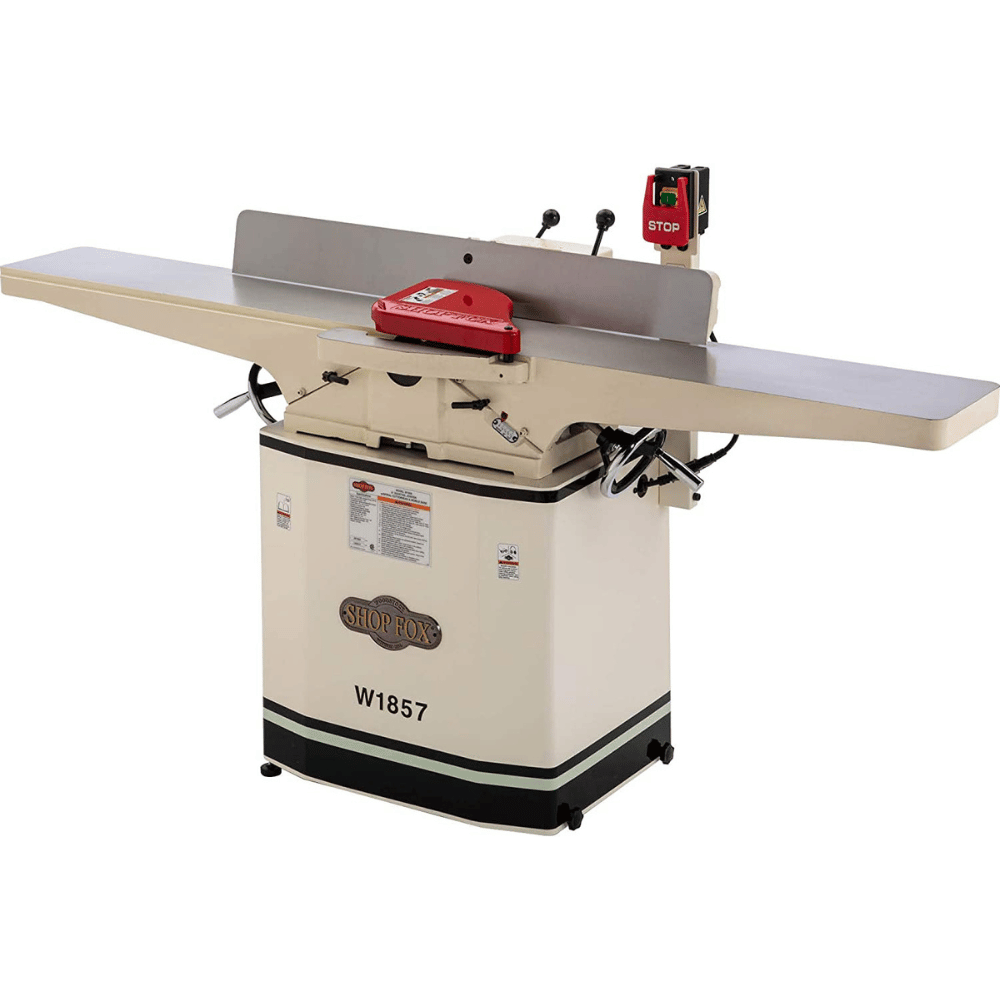
Shop Fox W1857-8″ x 72″ Dovetail Jointer with Mobile Base
Key Features
- 3 HP, 230V single-phase motor
- 8″ x 72″ cast iron jointer table
- 5,500 RPM cutter head speed for 22,000 cuts per minute
Why It’s a Great Choice
Are you a woodworker looking for an efficient and high-quality dovetail joiner?
If so, then the Shop Fox W1857-8″ x 72″ Dovetail Jointer with Mobile Base is the perfect tool for you.
With its four-knife cutter head, this incredible jointer provides 25% more cuts per minute than three-knife models, ensuring that your joints are being formed quickly and with a smoother finish that requires less sanding.
Other features of this jointer include a pedestal-mounted magnetic switch, built-in mobile base, heavy-duty cast-iron hand wheels, and an adjustable 4-5/8″-by-38″ cast iron fence that allows you to do surface planing, edge jointing, bevel cutting, and rabbeting — all with one powerful machine.
Get professional quality results without any of the hassles when you invest in the Shop Fox W1857 Jointer today!
Best Infeed and Outfeed Table Adjustment
Grizzly Industrial G0856-8″ x 72″ Jointer with Helical Cutterhead & Mobile Base

Key Features
- 3 HP, 230V single-phase motor
- 8″ x 72″ cast iron jointer table
- 5,500 RPM cutter head speed
Why It’s a Great Choice
The Grizzly Industrial G0856-8″ x 72″ Jointer with Helical Cutterhead & Mobile Base is designed for superior performance and accuracy no matter the project.
This ultimate woodworking tool is crafted from heavy-duty cast iron and features a helical cutter head and rabbet table for fast and accurate work.
The fence can be easily adjusted to 45 and 90 degrees with positive stops to make your job easier, while the adjustable tables are controlled via handwheels for convenience.
The convenient pedestal-mounted switch turns it on or off with ease.
For more efficient performance, the 4″ dust port helps keep your workspace clean when in use.
This precision jointer is designed to help any woodworker take their craftsmanship to new heights with smooth results every time!
Get this top-of-the-line jointer today and experience woodworking as it should be!
Best 6-Inch Jointer
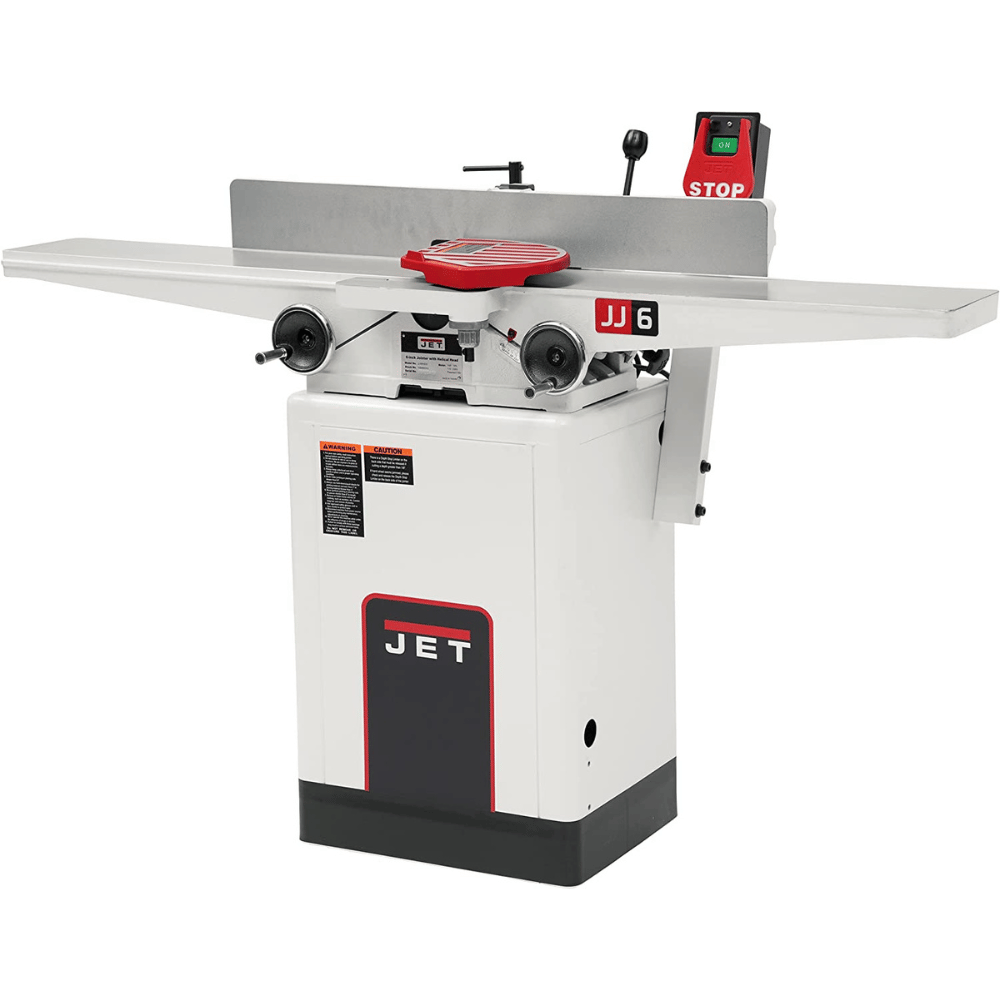
JET JJ-6HHDX, 6-Inch Long Bed Jointer (708466DXK)
Key Features
- 1 HP, 230V single-phase motor
- 8″ x 56″ cast iron jointer table
- Two-way tilting fence with stops at 45° and 90°
Why It’s a Great Choice
Introducing the new JET JJ-6HHDX, a 6-inch Long Bed Jointer that delivers superior control and performance.
Crafted with its center-mounted fence control conveniently located for easy adjustments and a two-way tilting fence with positive stops at 45° and 90°, this jointer is something no woodworker should be without.
It is equipped with a helical cutter head featuring 27 four-sided indexable carbide inserts that have been designed to provide a superior finish while operating quietly.
In addition to its impressive features, it comes with extra-long heavy-duty cast iron infeed and outfeed tables designed for precision machining as well as front-mounted table adjustment handwheels for quick and accurate corrections.
Experience the power of the JET JJ-6HHDX, 6-inch long bed jointer; an invaluable tool whether you’re a professional or a hobbyist.
Best Jointer for Fine-Tune Depth Adjustment
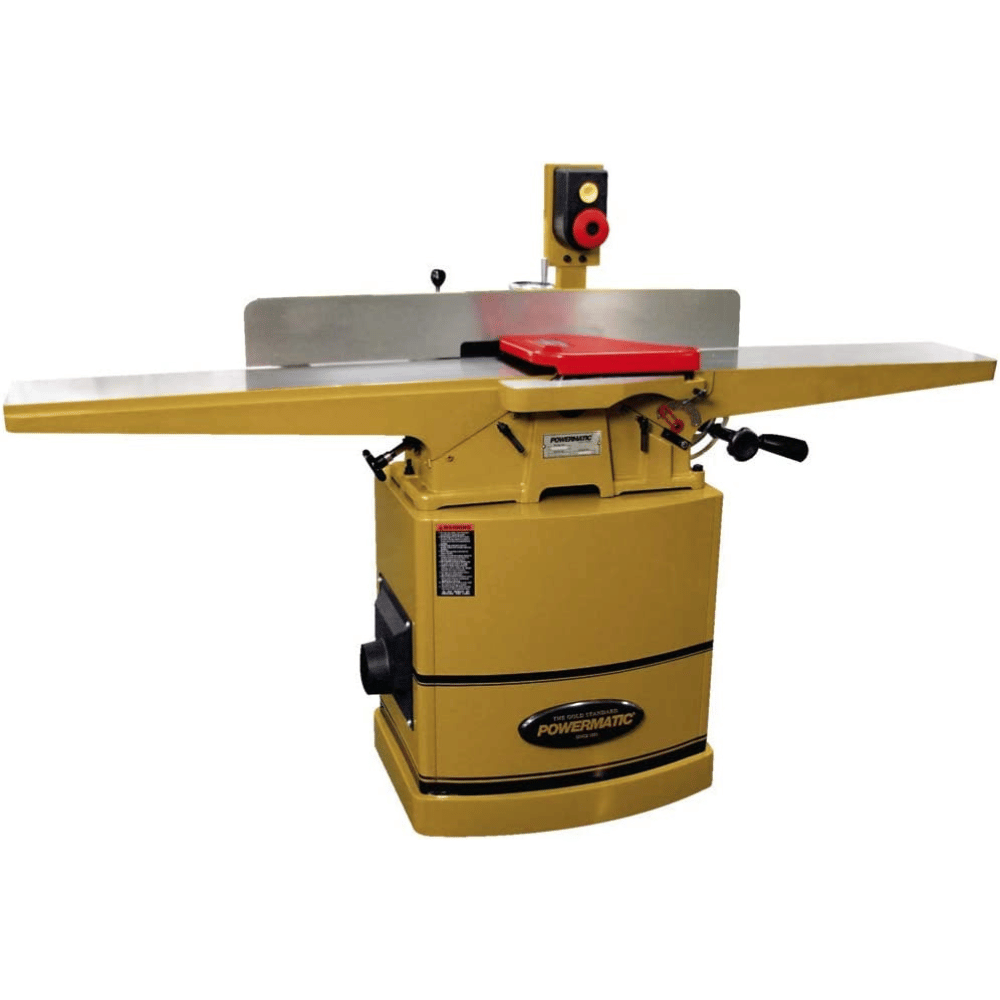
Powermatic 60HH, 8-Inch Jointer, Helical Head (1610086K)
Key Features
- 2 HP, 230V single-phase motor
- 8″ x 73″ cast iron jointer table
- 7,000 RPM cutter head speed
Why It’s a Great Choice
If you’re a professional, amateur, or weekend woodworker looking for the ultimate in jointing performance, the Powermatic 60HH 8-inch Jointer is just what you need.
With a revolutionary helical cutterhead that features 54 four-sided carbide inserts, this jointer will give you an ultra-smooth finish with quieter operation than any other.
Its easy-to-use adjust lever ensures quick infeed table positioning and smooth fence tilting with a handwheel-operated worm gear system.
The added convenience of its high-mount magnetic switch which is easily accessible makes this even more appealing.
Not to mention it comes with included magnetic push blocks which can be stored on the machine within arm’s reach at all times.
Don’t miss out on this great opportunity to experience flexible precision with the Powermatic 60HH 8-Inch Jointer; your projects will have never looked so good!
Buyer’s Guide to the Best Jointers
Shopping for a jointer can be intimidating and confusing because there are a lot of factors to consider.
A jointer is an important tool for any woodworker, but it’s not always easy to figure out which one is right for you.
There’s a lot to consider – from the size of your workshop to the type of wood you work with to your budget.
We’ve compiled the most common questions that people have when shopping for a jointer, and answered them all in this guide.
After reading these FAQs, you’ll be able to narrow down your choices and find the perfect jointer for your needs.
What is a wood jointer?
A jointer is a woodworking tool used to flatten and straighten the edges of rough lumber, allowing for tight-fitting joints and a professional-looking finished product. Essentially, a jointer works by passing the rough piece of lumber over a set of rotating blades, called the cutter head, which shaves off a thin layer of material to create a flat, smooth surface.
One of the key benefits of using a jointer is that it allows for consistent thickness across a piece of lumber. By flattening one side of the board, a jointer can then be used to create a parallel edge, ensuring that both sides of the board are of equal thickness.
Jointers come in a range of sizes, from small benchtop models to larger floor-standing machines. Some jointers also include additional features, such as spiral cutter heads or built-in dust collection systems, which can further improve the accuracy and efficiency of the tool.
Overall, if you’re serious about woodworking and want to produce high-quality projects, a jointer is an essential tool to have in your workshop. Whether you’re building furniture, cabinets, or other woodworking projects, a jointer will help you achieve precise, professional results.
How does a jointer work?
A jointer is a woodworking tool that is designed to flatten and straighten the edges of rough lumber. The tool works by removing small amounts of material from the surface of the board, creating a flat and smooth edge that is perpendicular to the face of the board.
The basic operation of a jointer involves passing the rough piece of lumber over a set of rotating blades, known as the cutter head. The cutter head is typically powered by an electric motor and contains a series of sharp blades that are positioned at an angle to the surface of the board.
As the board is passed over the cutter head, the blades shave off a thin layer of material, creating a flat and smooth surface. The process can be repeated multiple times, gradually reducing the thickness of the board until it is flat and smooth on both sides.
One of the key features of a jointer is the fence, which is a flat and straight surface that is positioned perpendicular to the cutter head. The fence helps to guide the board through the jointer and ensures that the edge of the board is straight and parallel to the face of the board.
Another important feature of a jointer is the infeed and outfeed tables, which are flat surfaces that support the board as it passes over the cutter head. The infeed table is typically positioned slightly lower than the outfeed table, which creates a slight downward pressure on the board as it passes through the jointer. This pressure helps to keep the board stable and prevents it from slipping or bouncing during the cutting process.
How large of material can a jointer handle?
The size of the material that a jointer can handle depends on the size of the jointer itself. Jointers come in a range of sizes, from small benchtop models to larger floor-standing machines, and each model has its limitations in terms of the size of material it can handle.
Generally, smaller benchtop jointers are designed to handle materials that are up to 6 inches wide and 1/2 inch thick. These jointers are ideal for smaller woodworking projects, such as making picture frames or small boxes.
Larger floor-standing jointers, on the other hand, can handle much larger pieces of material. Some models can handle materials that are up to 12 inches wide and 1 inch thick, while others can handle even larger pieces.
It’s important to note that while a jointer can handle larger pieces of material, it’s still important to take care when feeding the material through the machine. You should always make sure that the material is flat and free from any twists or warps, as these can cause the material to bind up in the jointer and potentially cause damage to the machine.
In summary, the size of the material that a jointer can handle depends on the size of the jointer itself, with smaller benchtop models designed for smaller materials and larger floor-standing models capable of handling larger pieces. It’s important to use care when feeding material through the jointer, regardless of its size.
What are the different types of blades available for a jointer?
There are several different types of blades available for jointers, each with their unique advantages and disadvantages. The most common types of jointer blades include straight knives, spiral cutter heads, and helical cutter heads.
Straight knives are the most traditional type of jointer blade and consist of a set of two or three straight blades that are installed in the cutter head. These blades are easy to sharpen and maintain, but they can produce more tear-out and require more frequent sharpening than other blade types.
A spiral cutter head, also known as an insert cutter head, uses multiple small cutting inserts that are arranged in a spiral pattern around the cutter head. These inserts are usually made of carbide and can be easily replaced when they become dull. Spiral cutter heads are known for producing less tear-out and noise than straight knives, but they can be more expensive and require a more complex setup.
A helical cutter head is similar to a spiral cutter head, but it uses a helix-shaped arrangement of cutting inserts that are angled for optimal cutting performance. The helical cutter head provides the smoothest and cleanest cuts, with minimal tear-out, but they are typically the most expensive option.
In addition to these blade types, some jointers also offer serrated or rippled blades, which can create unique textured surfaces on the wood.
When choosing the right type of blade for your jointer, consider your budget, the types of woodworking projects you’ll be working on, and your desired level of precision and finish. Ultimately, the right blade type will depend on your specific needs and preferences as a woodworker.
What safety features should I look for in a jointer?
Safety should always be a top priority when working with power tools like jointers. When shopping for a jointer, there are several safety features that you should look for to ensure that you can work safely and avoid injury.
One of the most important safety features to look for is a blade guard. This is a protective cover that sits over the jointer blades and prevents your fingers from coming into contact with them. Make sure that the blade guard is sturdy and easy to adjust so that you can access the blades for maintenance and blade changes when necessary.
Another important safety feature is a power switch that is easy to reach and turn off in case of an emergency. The power switch should be located in a position that you can quickly and easily access, even if you’re wearing gloves.
A good jointer should also have a built-in dust collection system to remove sawdust and debris from the work area. This not only helps to keep your workspace clean and tidy, but it also reduces the risk of fire and other hazards.
Lastly, look for a jointer with a stable and sturdy base, as this will help to prevent the machine from tipping or wobbling during use. Make sure that the base is wide enough to provide good stability and that the jointer is securely anchored to the base.
Overall, when shopping for a jointer, prioritize safety features that will protect you from harm and keep you safe during use. Look for a model with a blade guard, an easy-to-reach power switch, a built-in dust collection system, and a stable base. Remember to always read the manufacturer’s instructions and follow proper safety procedures when using any power tool.
How do I adjust the cutting depth and angle on a jointer?
Adjusting the cutting depth and angle on a jointer is an important step in getting the best results from your woodworking projects. Here are the steps to follow when adjusting these settings on your jointer:
Adjusting the cutting depth:
The first step in adjusting the cutting depth on a jointer is to turn off the machine and unplug it from the power source. Then, locate the adjustment lever or knob on the jointer that controls the depth of cut. Turn the knob or lever to adjust the depth of cut to the desired thickness.
It’s important to note that the depth of cut should be adjusted gradually, taking small increments at a time until you reach the desired thickness. Make sure to check the thickness of your wood after each pass to ensure that it matches the desired thickness.
Adjusting the cutting angle:
To adjust the cutting angle on your jointer, you will need to adjust the infeed table and outfeed table. First, unplug the jointer and turn off the machine. Locate the adjustment screws or knobs on the infeed and outfeed tables.
To adjust the cutting angle, loosen the screws or knobs on the infeed table and adjust it up or down to achieve the desired angle. Then, adjust the outfeed table to match the height of the infeed table. Tighten the screws or knobs on both tables to lock them in place.
It’s important to note that adjusting the cutting angle on a jointer can be a bit tricky and may take some practice to get it right. Make sure to take small increments at a time and test your wood after each pass to ensure that you’re getting the desired results.
In summary, adjusting the cutting depth and angle on a jointer is an important step in achieving the best results from your woodworking projects. Take your time and follow the manufacturer’s instructions carefully to ensure that you’re making the right adjustments.
How often should I lubricate and sharpen the blades on my jointer?
Proper maintenance of your jointer is essential to ensure that it functions efficiently and effectively. One of the most critical aspects of maintenance is keeping the blades well-lubricated and sharpened. The frequency of lubrication and sharpening, however, depends on a variety of factors, such as the frequency of use, the type of wood being processed, and the quality of the blades themselves.
In general, it is recommended that you lubricate your jointer blades after every use to prevent rust and to ensure smooth operation. This involves using a rust inhibitor or oil to coat the blades and prevent corrosion. You can also use a wax-based lubricant to reduce friction and extend the life of the blades.
Sharpening the blades is also an important aspect of jointer maintenance. Dull blades can lead to poor-quality cuts and can even damage the wood being processed. The frequency of sharpening will depend on how often you use the jointer and the hardness of the wood being processed. As a general rule, it’s a good idea to check the blades for dullness every 10-20 hours of use. If you notice that the blades are becoming dull, you should sharpen them immediately to maintain the quality of your work.
In conclusion, the frequency of lubrication and sharpening of jointer blades depends on several factors. However, it’s always best to err on the side of caution and check the blades after every use. Regular maintenance will not only extend the life of your jointer but will also ensure that your woodwork is of the highest quality.
Are there different types of jointer tables depending on their intended use?
Yes, there are different types of jointers available in the market, and their intended use varies based on the type of work you need to do. The two most common types of jointers are the benchtop jointer and the floor-standing jointer.
The benchtop jointer is designed for small woodworking projects and is ideal for hobbyists and DIY enthusiasts. It is a compact and portable tool that can be easily stored away when not in use. Benchtop jointers usually have a cutting width of around 6 inches, which is suitable for working with narrow boards.
The floor-standing jointer, on the other hand, is designed for larger woodworking projects and is used by professional woodworkers. It is a heavy-duty machine that is permanently mounted on the floor and has a wider cutting width of 8 to 16 inches. Floor-standing jointers can handle larger pieces of wood and produce smoother cuts than benchtop jointers.
Apart from the two most common types of jointers, there are other specialized jointers available for specific purposes. For example, a helical-head jointer has a spiral-shaped blade that produces a smoother and quieter cut, while a jointer-planer combo combines both jointing and planing functions in one machine.
In conclusion, jointers come in various types and sizes, each with its own intended use. When choosing a jointer, it’s important to consider the type of woodworking projects you’ll be working on and the amount of space you have in your workshop. With the right jointer, you can achieve precise and smooth cuts on your woodwork.
What is a jointer-planer combo machine and are they worth it?
A jointer-planer machine is a versatile woodworking tool that combines the functions of both a jointer and a planer in one machine. This machine is designed to provide woodworkers with a space-saving solution, as it eliminates the need to purchase and store two separate machines.
The jointer function of the combo machine is used to flatten and square the edges of boards, while the planer function is used to thickness boards to a desired thickness. The machine has a switch that allows the user to switch between the jointer and planer functions easily.
The advantage of jointer-planer combos is that they save space and can be a cost-effective solution for small woodworking shops or hobbyists who do not need to process large quantities of wood. Additionally, the combo machine is designed to work with boards of varying lengths and thicknesses, making it ideal for a variety of woodworking projects.
However, there are also some drawbacks to a planer-jointer combo machine. One disadvantage is that the machine’s size limits the size of the boards that can be processed. The machine also has a smaller motor compared to standalone jointers and planers, which means it may not be suitable for heavy-duty work or for processing large amounts of wood.
Whether jointer-planer combo machines are worth it depends on the individual’s needs and budget. If you have limited space and budget, a combo machine may be a good option. However, if you have more space and can afford standalone jointers and planers, they may offer more power and capacity for heavier-duty work.
In conclusion, a jointer-planer combo machine can be a valuable tool for smaller woodworking projects, but it may not be suitable for larger or more heavy-duty work. It’s important to carefully consider your needs and budget before deciding whether a jointer-planer combo machine is right for you.
Choosing the Best Jointer for You
In the end, a jointer is an essential tool for any woodworker, and completing a well-crafted project requires the proper resources.
We’ve done the research and presented you with our top choices when it comes to jointers.
With productive features ranging from powerful motor options to long cuts available at widths up to 8 inches wide, these machines have your woodworking needs in mind!
Now you’re ready for the next step.
Click the links we’ve provided to check out current pricing and order your new jointer now!