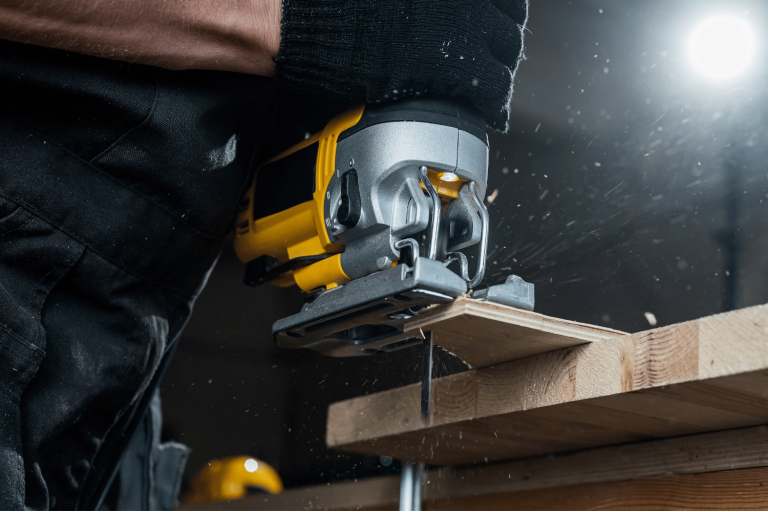
Reciprocating Saw Vs Jigsaw: A Cutting Edge Showdown

Are you in the market for a new saw, but can’t decide between a reciprocating saw or a jigsaw? Look no further!
In this article, we will explore the key differences between these two powerful tools and help you determine which one is the best fit for your specific needs. Reciprocating saws and jigsaws are both versatile and commonly used tools in the world of power tools. However, each saw has its own unique strengths and weaknesses.
Whether you are a professional contractor or a DIY enthusiast, it’s crucial to choose the right tool for the job. With our cutting edge showdown between reciprocating saws and jigsaws, you’ll be able to make an informed decision and tackle your next project with confidence.
So, let’s dive in and discover which saw will be the perfect addition to your toolbox!
Type of Saw
So, if you’re looking to choose between a reciprocating saw and a jigsaw, it’s important to consider the type of saw that will best suit your specific project needs and preferences.
Jigsaw vs Reciprocating Saw – Uses
Reciprocating saws are heavy-duty tools that are ideal for demolition work and cutting through tough materials like wood, drywall, and metal. They feature a reciprocating blade movement that allows for quick back and forth or push and pull cutting.
On the other hand, jigsaws are better suited for woodworking and home improvement projects that require more precise cuts. They have a smaller reciprocating blade than reciprocating saws and can perform straight or curved cuts, crosscutting, plunge cuts, and bevel and miter cuts.
Jigsaw vs Reciprocating Saw – Blades
When it comes to the blades, reciprocating saws have a variety of blade types that can handle different materials, while jigsaws have U-shank and T-shank blades for creating intricate shapes.
Another factor to consider is whether you want a corded or cordless saw. Cordless options are available for both types, but cordless reciprocating saws tend to be smaller and less powerful than their corded counterparts, while cordless jigsaws can provide the same cutting power as corded models.
Ultimately, the decision between a reciprocating saw and a jigsaw will depend on the intended use and required precision.
To summarize, if you need a saw for heavy-duty work, a reciprocating saw is the way to go. If you need a saw for woodworking and precise cuts, a jigsaw is the better option. Consider the type of saw blade and whether you want a corded or cordless saw when making your decision.
With that said, let’s move on to the features and design of these two types of saws.
Features and Design
You’ll love the features and design of both the reciprocating saw and jigsaw. The reciprocating saw features a horizontal hognose design, while the jigsaw is more compact and vertical, with a handle along the top of a compact body. Both tools utilize a push-pull blade mechanism, but blade motion may include orbital or pendulum action. They also feature variable speeds and many blade options for cutting different materials.
The reciprocating saw can cut through wood, most metals, lumber, plywood, and wood with nails in it. Meanwhile, the jigsaw can cut through much more than ordinary saws, making it a versatile power tool. It also has a keyless blade change and 4-position orbital action. Both tools come in corded and cordless models, giving you the option to choose the one that suits your needs.
When it comes to the design, the jigsaw is more suitable for intricate cuts and curves, while the reciprocating saw is best for heavy-duty cutting and demolition. The jigsaw has a stable base for blade positioning, making it ideal for precise cuts. The reciprocating saw has a blade that comes out parallel in front of the tool, making it suitable for rough cuts.
Understanding the features and design of each tool will help you determine which one is ideal for your project. Suitable projects vary for each tool, and the next section will discuss this in detail. But keep in mind, the features and design of each tool play a vital role in determining their suitability.
By understanding these factors, you’ll be able to make an informed decision about which tool to use for your next project.
Suitable Projects
If you’re looking to tackle a home improvement project, it’s important to know which tool is best suited for the job at hand. When it comes to cutting materials, the reciprocating saw and jigsaw are both versatile saws that can handle a wide range of tasks. However, there are differences between the two that make them better suited for certain projects.
Here are three factors to consider when choosing between a reciprocating saw and a jigsaw for your project:
• If your project requires precise and intricate curved cuts, a jigsaw is the better option. The saw blade on a jigsaw is smaller and can easily maneuver through tight curves.
• Reciprocating saws are better suited for heavy-duty cutting through materials like metal, brick, and drywall. Jigsaws are better for softer materials like wood and plastic.
• Reciprocating saws are designed for demolition work and rough cuts, while jigsaws are better for woodworking and home improvement projects. If you need a saw that can handle a variety of tasks, a reciprocating saw is the better choice.
With these factors in mind, you can choose the saw that’s best suited for your project.
In the next section, we’ll discuss the different blades and accessories available for reciprocating saws and jigsaws.
Blades and Accessories
Let’s dive into the world of blades and accessories for these versatile power saws. Reciprocating saws are a powerful tool that can cut through different materials with ease. They come with a variety of reciprocating saw blades that are designed to handle different cutting tasks.
For instance, some blades are ideal for cutting through wood, while others are designed to cut through metal pipes and conduit. You can also find reciprocating saw blades that are suitable for pruning trees and shrubs, making it a versatile tool for outdoor projects.
On the other hand, jigsaws come with a jigsaw blade that moves up and down to make intricate cuts. These blades are designed to cut through different materials such as wood, metal, and plastic. Jigsaw blades come in various shapes and sizes, including U-shank and T-shank blades.
U-shank blades are designed to fit into a U-shaped slot in the jigsaw, while T-shank blades are designed to fit into a T-shaped slot. You can choose the right blade for your jigsaw depending on the type of cut you want to make.
Both reciprocating saws and jigsaws come with a variety of blades and accessories that are designed to handle different cutting tasks. While reciprocating saw blades are ideal for heavy-duty cutting, jigsaw blades are designed to make intricate cuts. It’s important to choose the right blade for your saw to ensure that you get the best results.
In the next section, we’ll compare reciprocating saws and jigsaws to help you make an informed decision.
Comparison and Conclusion
Get ready to make the right choice for your next cutting project by comparing the powerful and versatile reciprocating saw with the precise and efficient jigsaw. Understanding the differences between the two saws will help you determine which one will work best for your project.
When it comes to precise cuts, the jigsaw is the go-to tool. Its smaller reciprocating blade allows for more intricate cuts and patterns, making it perfect for woodworking and home improvement projects. The jigsaw’s stable base and U-shank and T-shank blades allow for bevel and miter cuts, straight or curved cuts, crosscutting, and plunge cuts.
On the other hand, the reciprocating saw prioritizes working capacity over accuracy. With its powerful motor and variety of blade types, it can perform rough cuts and cut a variety of materials, making it ideal for demolition work and cutting wood, nailed wood, drywall, metal, bricks, and more.
Ultimately, the decision between the two tools depends on the intended use and required precision.
Final Thoguhts
Congratulations! You’ve now learned about the differences between reciprocating saws and jigsaws.
As you’ve seen, these two saws have unique features and designs that make them suitable for specific projects.
When it comes to selecting the right saw for your needs, it’s important to consider the type of cutting you’ll be doing.
If you require heavy-duty cutting and demolition work, then a reciprocating saw is the tool for you.
On the other hand, if you need precise cuts and woodworking, then a jigsaw is the way to go.
To help you better understand the difference between these two saws, let me share a metaphor with you.
Reciprocating saws are like sledgehammers, powerful and effective at breaking things apart.
Jigsaws, on the other hand, are like scalpels, precise and delicate in their cuts.
So, just as a surgeon wouldn’t use a sledgehammer in the operating room, you wouldn’t want to use a reciprocating saw for fine woodworking.
Whether you choose a reciprocating saw or a jigsaw, both tools have their strengths and weaknesses.
By understanding the type of cutting you’ll be doing, you can make an informed decision on the right saw for your project.